
This is Part 2 of our comprehensive guide to Service Robotics in 2025. Read Part 1 for the introduction and robot categories overview.
The AI Revolution in Robotics
Neural Networks as Intelligence Foundation
Artificial intelligence fundamentally transforms service robotics rules. The defining characteristic of contemporary service robots lies in their cognitive capabilities. Through neural networks and machine learning, they transcend programmed actions to actively adapt to their surroundings.
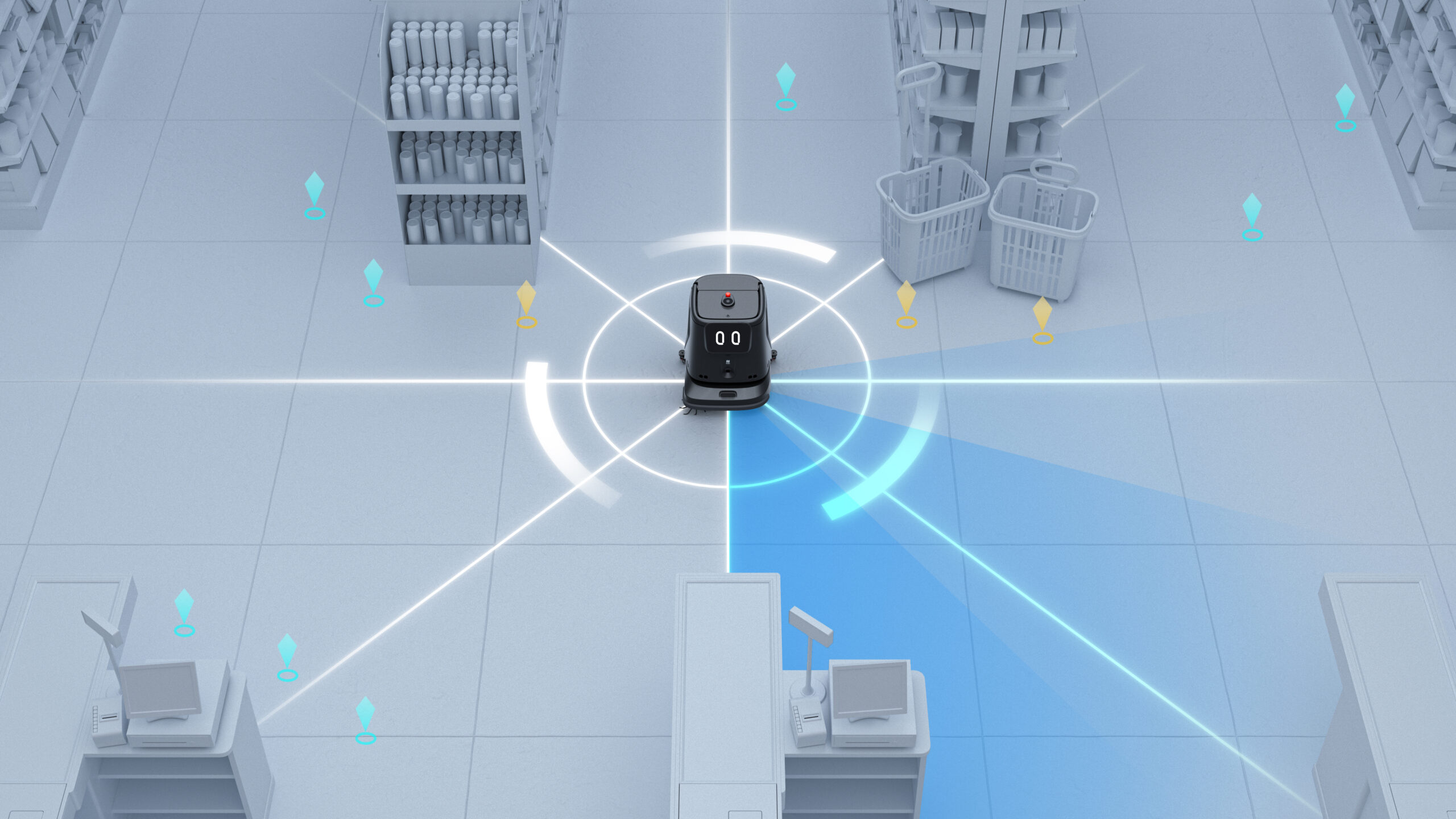
Consider a straightforward scenario: a robot server encounters an obstacle in its path. Previous generations would simply halt and wait. A modern robot analyzes circumstances, constructs alternative routes, and if necessary — courteously requests a person to relocate using synthesized speech.
Continuous Learning and Adaptation
Furthermore, these systems perpetually learn. Every interaction, every unusual situation enhances their intelligence. Cloud technologies enable robots to share experiences — knowledge acquired by one robot in Tokyo instantly becomes accessible to counterparts in Moscow or New York.
This generates a distinctive collective intelligence system where each robot contributes to a common knowledge repository. The outcome is continuous performance and reliability improvements across the entire network.
Multimodal Perception
Contemporary service robots possess multimodal perception, integrating computer vision, audio processing, tactile feedback, and chemical sensors. This enables comprehensive environmental understanding and more informed decision-making.
For instance, a robot server simultaneously recognizes dishes visually, processes customer orders audibly, senses plate temperature through touch, and even evaluates food freshness. Such perception levels were unattainable just years ago.
Flexibility and Programmability
Universal Platforms
Among the most underappreciated features of modern service robots is their adaptability. These are not narrowly specialized machines but universal platforms configurable for diverse tasks.
A restaurant can program a robot not merely for dish delivery but also for entertaining children with simple performances. Hotels can configure identical robots as concierges providing attraction information in multiple languages. Hospitals can reconfigure them for laboratory sample transport.
Modular Architecture
This flexibility derives from open APIs and modular architecture. Owners need not be programmers — most configurations occur through intuitive interfaces resembling visual constructors.
Modular architecture facilitates easy addition of new functions, software updates, and adaptation to evolving requirements. This renders service robotics investments more attractive for businesses.
Development Ecosystem
A comprehensive developer ecosystem is forming around service robotics, creating specialized applications and modules. Similar to smartphone app stores — robot owners can select from numerous ready solutions or commission development for specific needs.
Economic Efficiency of Robotics
Return on Investment Analysis
Let us examine service robotics economics honestly: the fundamental business question concerns profitability. Numbers speak definitively. An average robot server costs equivalent to two employees' annual salaries but operates three shifts without weekends or sick leave. A cleaning robot replaces 3-4 workers while improving quality through systematic methodology.
Beyond direct salary savings, robots eliminate human errors, reduce insurance expenses, require no training or retraining. Their productivity remains predictable, unaffected by mood, fatigue, or personal circumstances.
Marketing Effect
Savings represent only part of the equation. Robots become customer attractions. Restaurants with robot servers report 20-30% attendance increases during initial months. Visitors come for the experience, capture photos and videos, promoting establishments freely through social media.
This effect proves especially valuable for branding. Companies implementing service robotics position themselves as innovative and technologically progressive. This attracts customers and talented employees alike, particularly from younger demographics.
Long-term Investment
Service robotics represents long-term investment. Modern robots serve 5-7 years under intensive use, with software updatable to add new functions without hardware replacement.
Additionally, robot costs continue declining while capabilities expand. This creates positive dynamics for investors and makes technology accessible to growing numbers of companies.
Human-Robot Synergy
Complement, Not Replace
Understanding is essential: service robotics complements rather than replaces humans. In restaurants, robots deliver dishes while human servers create atmosphere, recommend wines, and resolve non-standard issues. In warehouses, robots move goods while people handle planning, quality control, and customer service.
This liberates employees from routine, enabling focus on creative and communicative tasks. Research demonstrates that companies implementing robots see increased staff satisfaction — people feel more valued performing genuinely important work.
New Professions and Skills
Service robotics creates new professions requiring new skills. Robot technicians, maintenance specialists, and robotic system data analysts are emerging. These well-compensated positions require high qualifications.
Existing employees also benefit. Servers learn coordinating with robot colleagues, developing management skills. Cleaners become robotic system operators, gaining technical competencies.
Improved Working Conditions
Robots assume the heaviest, most hazardous, and monotonous tasks. This significantly improves human working conditions. Loaders no longer lift heavy objects, cleaners avoid aggressive chemicals, medical workers reduce infection exposure risks.
Industry Transformations
Restaurant Business
Service robotics implementation proves particularly active in dining establishments. Robot chefs prepare simple dishes, robot servers attend customers, cleaning robots maintain hygiene. This enables restaurants to operate more efficiently with consistent service quality.
Fully automated restaurants where robots perform most operations present particular interest. Such establishments operate continuously with minimal staff, offering affordable pricing and high quality.
Logistics and Warehousing
In logistics, service robotics has generated genuine revolution. Automated warehouses with sorting robots, loading robots, and delivery drones operate many times more efficiently than traditional facilities.
"Last mile" delivery achievements prove especially impressive. Courier robots already deliver packages in certain cities, while delivery drones undergo testing for lightweight cargo transport to remote locations.
Healthcare
Healthcare service robotics addresses critically important tasks. Disinfection robots eliminate pathogens in hospital wards, courier robots transport medications and samples, assistant robots provide patient care.
Robot capability to work in hazardous conditions proved especially valuable during COVID-19. Robots minimized medical staff risks while maintaining necessary patient care.
Retail
Retail service robotics improves service quality and optimizes operations. Consultant robots help shoppers locate items, inventory robots track stock levels, cleaning robots maintain store cleanliness.
Integration with online systems enables omnichannel shopping experiences where physical store robots coordinate with mobile applications and online platforms.
Technological Trends and Innovations
Artificial Intelligence and Machine Learning
AI development remains the primary innovation driver in service robotics. New machine learning algorithms enable robots to better understand context, predict human behavior, and adapt to novel situations.
Natural language processing developments prove particularly promising, enabling more natural human-robot communication. Future robots will comprehend not merely commands but emotions, intentions, and conversational subtext.
Sensor Technologies
Sensor technology progress makes robots more sensitive and precise. New lidar types, cameras, and tactile sensors enable robots to better perceive and interact with their environment.
Artificial touch developments present particular interest. Next-generation tactile sensors allow robots to sense texture, temperature, pressure, and even chemical composition.
Energy Solutions
Battery and energy system improvements prove critically important for service robotics. New battery types provide extended operation while wireless charging systems enable automatic recharging without human intervention.
Alternative energy source developments, such as fuel cells, open new possibilities for robots operating outdoors or in remote locations.
The Future of Service Robotics
Near-term Forecasts
What awaits us in the coming 5-10 years? Experts predict companion robots for elderly individuals, autonomous couriers for last-mile delivery, intelligent retail assistants selecting goods based on personal preferences.
Physical and digital world boundaries continue blurring. Restaurant robots connect to smartphone applications, remembering favorite dishes. Office cleaning robots integrate with meeting room booking systems, intensifying cleaning before important gatherings.
Smart City Integration
Service robotics will become integral to smart city concepts. Robots will integrate into urban infrastructure, assisting with traffic management, street cleaning, and public space maintenance.
This creates new opportunities for improving urban quality of life and increasing municipal service efficiency.
Personalization and Adaptation
Future robots will exhibit greater personalization and adaptability. They will study specific user preferences and habits, offering individualized interaction experiences.
Machine learning will enable robots to understand not only what needs doing but how to accomplish it optimally for each specific person or situation.
Challenges and Obstacles
Technical Limitations
Despite impressive progress, service robotics still confronts technical limitations. Robots cannot yet fully replace humans in tasks requiring creativity, empathy, or complex decision-making in unpredictable circumstances.
Reliability and safety concerns remain relevant, especially in critical applications. Further research and development are necessary to address these challenges.
Social and Ethical Issues
Service robotics implementation raises important social and ethical questions. Concerns regarding employment displacement, data privacy, and technology dependence require serious consideration.
Ethical standards and regulations need development to ensure responsible robotics advancement and implementation.
Economic Barriers
High robot costs and specialized maintenance requirements remain barriers for many companies, particularly small and medium enterprises. New business models and financial instruments are needed to expand technology accessibility.
Conclusion: Time to Act
We stand at the threshold of a new service robotics era. Those mastering these technologies first will secure serious competitive advantages. History demonstrates: companies ignoring the internet in the 1990s or mobile technologies in the 2000s lost market positions.
The encouraging news is that starting today is possible. Technologies have become accessible and implementation straightforward. Technical expertise or million-dollar budgets are unnecessary.
Service robotics represents more than technological trend — it signifies fundamental change in how we work, live, and interact with the world. 2025 has genuinely become a pivotal year for this industry, and we are only beginning to comprehend these changes' full depth.
The future has arrived, populated by robots making our lives better, safer, and more efficient. The question is not whether the service robotics era will come — it is already here. The question is whether we are prepared to participate in this future.
Service Robotics in Armenia
Businesses in Armenia ready to embrace service robotics can partner with ASMO Robotics. As an authorized distributor for premium brands including PUDU and KEENON, ASMO provides end-to-end consultation, implementation, and support services. Contact ASMO to explore how service robots can transform your operations — whether in hospitality, healthcare, retail, or logistics.